
 Español




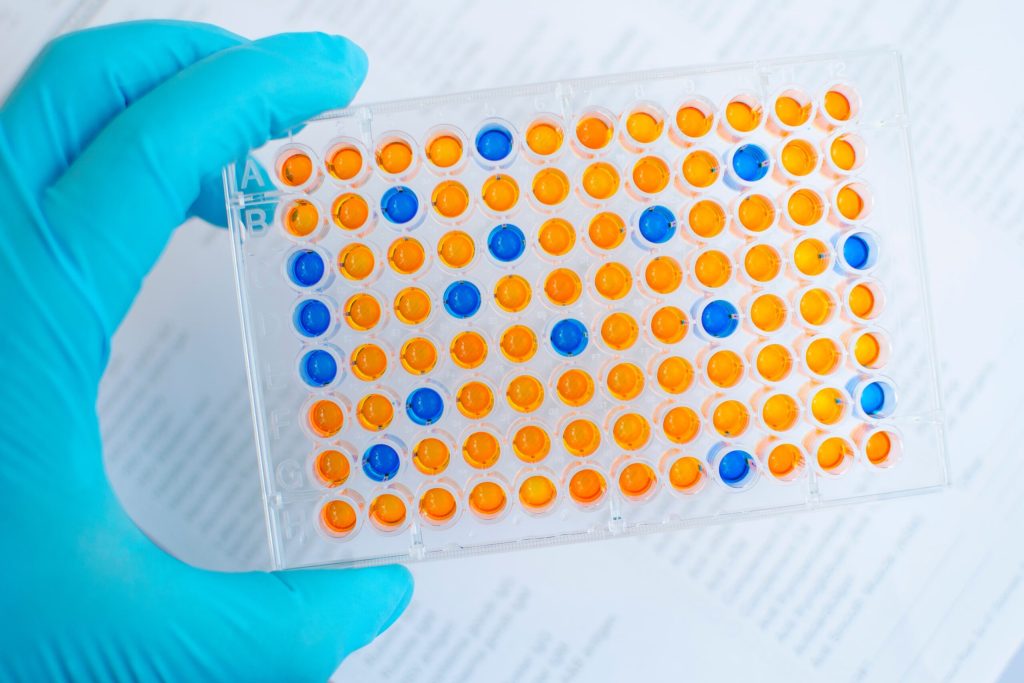

ELISA is a serological test that, in clinical analysis, is frequently used to detect and measure different biomarkers in blood or urine. The name ELISA stands for Enzyme linked immunosorbent assay.
ELISAs can be used to detect everything from antibodies, hormones and enzymes to viruses and bacteria. This versatility makes them ideal for use in a variety of settings, from hospitals and clinics to research laboratories.
Prior to the advent of COVID-19, it was already a commonly used test for HIV, the virus that causes AIDS, early cancer, hepatitis B and C, herpes simplex virus 1 and 2 and varicella zoster virus (the virus that causes chickenpox).
What does the test consist of?
The principle behind ELISA is that antibodies will bind to specific antigens.
In the more traditional ELISA test, where antibodies are detected, a sample is added to a plate that has been coated with an antigen. If antibodies are present in the sample (e.g. serum), they will bind to the antigen on the plate. A second antibody that recognises the bound antibodies is then added to the plate. This antibody is linked to an enzyme, which will produce a detectable reaction (colour change) if it binds to an antibody molecule.
ELISA tests are highly reliable and specific for detecting antibodies or other analytes in a sample. In addition, they often have excellent detectability and can therefore quantify very low levels of the marker of interest.
ELISA test results
ELISA tests can be qualitative as well as quantitative. And they are widely used to measure levels of antibodies or other relevant proteins related to health status.
For the analysis of antibodies of different isotypes (IgG, IgM, IgA…), the ELISA test can provide very useful and reliable information. For example, it is typical for infections to assess IgG and IgM: IgG antibodies (past infection) and IgM antibodies (acute phase infection):
- IgG or immunoglobulin G antibodies are produced in response to a previous infection and can provide reliable information about immunity. They are usually detected 10 days after the infection has passed and their concentration increases progressively.
- IgM or immunoglobulin M antibodies are produced in response to a current or recent infection and can provide information about the presence of an infection. They can usually be detected between days 4 and 7 of infection.
There are four possible outcomes:
1.- IgM and IgG negative: No evidence of current or previous infection.
2.- IgM positive and IgG negative: This result indicates that the patient is in the early stages of the disease. It is therefore infected and can be contagious.
3.- IgM positive and IgG negative: The patient is in an intermediate stage of the disease in which the body is beginning to generate antibodies for immunisation.
4.- IgM negative and IgG positive: There is a recovery of the disease and the patient is less likely to be contagious.
Advantages of ELISA tests
The advantage of ELISA tests is that they are very sensitive and can detect very small amounts of antibodies. They are also relatively easy to perform and results can usually be achieved within a few hours.
As a result, ELISA tests can often identify infections or other health problems before they cause noticeable symptoms. In addition, ELISA tests can often distinguish between different types of infections or diseases. This specificity can be key to diagnosing complex medical problems.
ELISA tests are some of the most widely used diagnostic tools in the world.
At CQS we perform ELISA tests and we have the most advanced equipment and qualified professionals that guarantee the quality of the results issued.
>> Request an appointment at the Laboratory (Madrid)
We are the first private clinical laboratory accredited in Spain by ENAC (National Accreditation Entity) according to the international standard UNE-ISO 15189:2013 (No. 659/LE1318).